
Why fuel choice matters
At some point every build hits the same wall: pump gas. You add boost, add timing, and eventually the engine starts knocking before it runs out of anything else. That's when the alcohol fuels come up, and with them a lot of half-truths.
E85 "makes more power." Methanol is "only for drag cars." Both are partly true, but neither tells you what actually changes on your car. This post covers what each fuel does differently from 91 or 93 octane, how much more of it your engine needs, what that means for injectors and pumps, and where each one makes sense.
The baseline: 91 and 93 octane pump gas
Pump gas is cheap, available everywhere, and dense with energy. That's why it gets the best fuel economy of anything here. Its weakness is knock resistance.
Octane isn't power. It's how well a fuel resists igniting on its own before the spark fires. Once cylinder pressure and heat get high enough, pump gas detonates, and your tuner has to pull timing or boost to keep the engine alive. On a stock or lightly modified car, 93 is plenty. On a big turbo build, it becomes the limit long before the turbo or engine is.
It also does very little to cool the intake charge. That matters, because the alcohols' biggest advantage over gas is how much heat they pull out of the air as they evaporate.
E85: the street-friendly upgrade
E85 is the alcohol fuel most of us can actually buy at a gas station. It's a blend of ethanol and gasoline, and it behaves like roughly 100 to 105 octane in a tuned engine. It also cools the intake charge far better than gas does. Together, that lets your tuner run more timing and more boost before knock shows up.
The catch is energy. Ethanol carries less energy per gallon than gasoline, so the engine needs about 30 to 35% more fuel to make the same power. Your fuel economy drops by about that much, and your injectors and pump have to keep up.
The other thing to know is that "E85" isn't always 85%. Pump E85 can legally range from about 51 to 83% ethanol, and the blend shifts with the season and the station. Winter blends often carry less ethanol to help cold starts. That's why a flex-fuel sensor is worth it on any serious E85 build. It reads the real ethanol content and lets the ECU adjust fueling and timing on the fly, instead of assuming every tank is the same.
E85 is also hard on fuel system parts that weren't made for it, and it pulls moisture from the air. Make sure your pump, lines, and seals are ethanol-compatible, and don't let a tank of it sit for months. Alcohol fuels can also dilute your engine oil faster, which we covered in our Driven GP-1 oil post.
Methanol: M1 vs M5
Methanol is the heavy hitter. It resists knock even better than E85 and has the strongest cooling effect of any fuel here, which is why it shows up in drag, tractor pull, and dirt oval racing. The price you pay is volume: methanol needs roughly twice as much fuel as gasoline for the same power, sometimes more.
VP Racing's two common methanol products are M1 and M5, and they aren't interchangeable.
|
|
VP M1 |
VP M5 |
|---|---|---|
|
What it is |
High-purity racing methanol (99.5% or better) |
Methanol with power additives (nitrated compounds) |
|
Power |
Baseline methanol |
VP rates it at 5 to 7% more than standard methanol |
|
Tuning |
Standard methanol tune |
Needs tune changes when switching from M1 |
|
Water test |
Passes |
Won't pass, since it isn't pure methanol |
|
Class legality |
Legal anywhere methanol is allowed |
Check your class rules first |
VP recommends running its M2 upper cylinder lubricant with M1, since straight methanol does nothing to lubricate. M5's additive package is the reason it makes more power, and it's also why some classes don't allow it.
Methanol is not a street fuel. It eats aluminum and rubber that aren't rated for it, absorbs water quickly, and is toxic through skin contact and fumes. It also burns with an almost invisible flame, so a fire can be hard to see. Most methanol racers drain or flush the system after an event and change oil far more often than a gas car would.
AFR vs lambda: why your wideband reads "rich"
Switch to E85 and your gauge might show 9.8:1 at cruise, which looks dangerously rich if you're used to gas. It isn't. Every fuel has its own stoichiometric air-fuel ratio, the point where it burns completely. Lambda fixes the confusion: lambda 1.0 is stoichiometric on any fuel, and anything under 1.0 is rich.
|
Fuel |
Stoich AFR (λ 1.0) |
AFR at λ 0.85 |
AFR at λ 0.80 |
|---|---|---|---|
|
Gasoline (91/93) |
14.7 |
12.5 |
11.8 |
|
E85 |
~9.8 |
~8.3 |
~7.8 |
|
Methanol (M1) |
6.4 |
5.4 |
5.1 |
E85 values move with the actual ethanol content, and M5's additives shift its numbers slightly. That's exactly why most tuners log and target lambda instead of AFR. If your wideband or ECU can display lambda, use it. Your actual wide-open-throttle target depends on the engine, boost, and fuel, so leave that call to your tuner.
Injectors and fuel pumps: sizing for the fuel you run
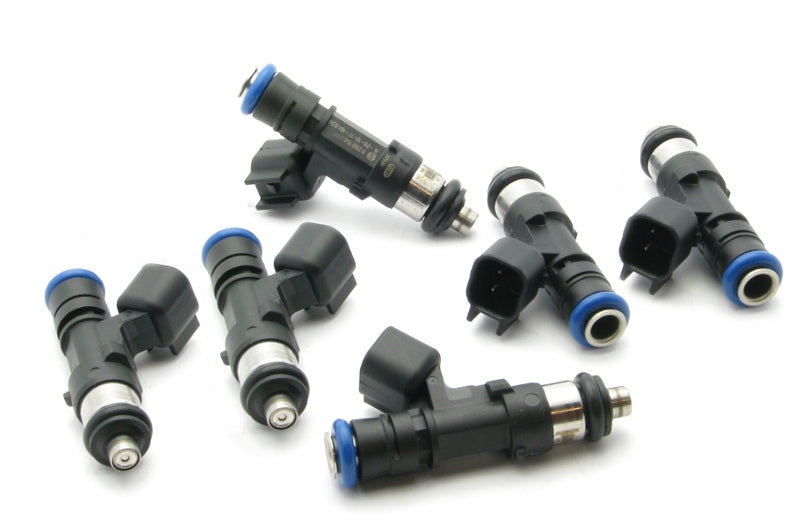
The same power goal needs about a third more injector on E85 and about double on methanol. Here's the standard formula for sizing injectors:

BSFC (brake specific fuel consumption) is how many pounds of fuel the engine burns per horsepower per hour. It's where the fuel type comes in. Multiply lb/hr by about 10.5 to get cc/min.
Example: a 600 crank horsepower turbo 2JZ inline-six, at an 80% max injector duty cycle.
|
Fuel |
Typical boosted BSFC |
Injector size |
Total fuel flow |
|---|---|---|---|
|
Gasoline |
0.60 |
~75 lb/hr (~800cc) |
~360 lb/hr |
|
E85 |
0.80 |
~100 lb/hr (~1,050cc) |
~480 lb/hr |
|
Methanol |
1.20 |
~150 lb/hr (~1,600cc) |
~720 lb/hr |
These are starting points. Naturally aspirated engines use lower BSFC values, and every engine is a little different. Always round up to the next available injector size.
The pump has to keep up too. Going from gas to methanol on that same engine doubles the fuel you need to move. Pump flow ratings also drop as fuel pressure rises, and on a boosted car the pressure rises with boost. Check the pump's flow chart at your real operating pressure, not the advertised number. Methanol builds often go to a mechanical belt-driven pump or multiple electric pumps for that reason.
Don't forget the rest of the system: lines, filters, rails, and regulators all need to be sized for the flow and rated for the fuel.
Pros and cons side by side
|
|
Pump gas (91/93) |
E85 |
Methanol M1 |
Methanol M5 |
|---|---|---|---|---|
|
Knock resistance |
Lowest |
High |
Very high |
Very high |
|
Charge cooling |
Minimal |
Strong |
Strongest |
Strongest |
|
Fuel needed vs gas |
Baseline |
~30 to 35% more |
~2x or more |
~2x or more |
|
Street use |
Yes |
Yes, with a flex sensor |
No |
No |
|
Availability |
Everywhere |
Select gas stations |
Race fuel suppliers |
Race fuel suppliers |
|
Fuel system changes |
None |
Bigger injectors and pump, compatible lines |
Full alcohol-rated system |
Full alcohol-rated system |
|
Biggest drawback |
Knock limits power |
Blend varies, worse mileage |
Corrosive, toxic, high maintenance |
Same as M1, plus class legality |
Which fuel fits your build?
- Daily driver or light bolt-ons: stick with 93. The power you'd gain on E85 isn't worth the fuel system changes and the hit to mileage.
- Street car making real boost: E85 with a flex-fuel sensor is the sweet spot. You get race-fuel knock resistance from a gas station pump, and the car can still run gas when E85 isn't around.
- Dedicated drag, pull, or oval car: methanol. Start with M1 if you want a simple, class-legal fuel. Step up to M5 if your class allows it and you want the extra 5 to 7%.
Whichever way you go, plan the fuel system around the fuel before you chase the power. Injectors, pump, lines, and a good tune come first.
Build your fuel system right
SpeedTuned Motorsports carries fuel injectors, pumps, rails, regulators, and AN lines and fittings for every one of these fuels. If you're not sure what your build needs, reach out. We'll help you size it before you buy.