
AN Fittings 101: A Beginner's Guide to Sizing, Types, and Picking the Right Fitting for Your Build
If you've ever stared at a wall of fittings trying to figure out the difference between an AN-6 and an AN-8, or wondered why your buddy's fuel line "just fits" and yours doesn't — you're not alone. AN fittings look intimidating at first, but once the sizing logic clicks, you'll never second-guess a parts order again. If you're ready to compare options, browse our Vibrant Performance fittings and hose collection for practical starting points.
No gatekeeping, just answers. Here's everything you need to know before your next fuel, oil, or brake line upgrade.
What Does "AN" Even Mean?
AN stands for Army-Navy, a fitting standard that dates back to WWII aircraft hydraulics. The military needed a fitting that could handle vibration, pressure, and heat without leaking — and it turned out to be so reliable that racing and street performance builds adopted it decades ago. That's why AN fittings are the go-to for fuel systems, oil lines, brake lines, and turbo plumbing on anything built to actually perform.
The big advantage over factory hose clamps and barbed fittings: AN fittings use a 37-degree flare seal, which means metal-to-metal contact does the sealing, not a rubber gasket or a clamp crushing a hose. That's a huge deal under vibration and heat cycling — nothing to dry-rot, nothing to slowly loosen over 20,000 miles of engine bay heat soak. For examples of the standard in real parts, see the Vibrant -6 AN flare union and Vibrant -8 AN flare union.
Cracking the Size Code
This is where most people get stuck, so let's simplify it. AN fitting sizes are labeled by a dash number (AN-4, AN-6, AN-8, AN-10, etc.), and that number represents the fitting's size in sixteenths of an inch, based on the outside diameter of the tubing the standard was originally built around.
Here's the cheat sheet for the sizes you'll run into most on a street/race build:
| Dash Size | Approx. Hose ID | Common Use |
|---|---|---|
| AN-3 | 3/16" | Brake lines, gauge lines |
| AN-4 | 1/4" | Oil feed lines, small brake lines |
| AN-6 | 3/8" | Fuel lines (most naturally aspirated & mild boost builds) |
| AN-8 | 1/2" | Fuel lines (high-power/turbo builds), oil lines |
| AN-10 | 5/8" | Big turbo fuel supply, oil drain lines |
| AN-12 | 3/4" | Oil drains on big turbo setups, dry sump systems |
| AN-16 | 1" | Coolant systems, mechanical fuel systems on race cars |
| AN-20 | 1-1/4" | Coolant systems, mechanical fuel systems on race cars |
Rule of thumb: don't just size up "to be safe." Oversized fuel lines can actually hurt fuel pressure stability at idle and low flow, and they cost more for hose, fittings, and clamps you don't need. Match the size to your fuel pump output and horsepower goal — if you're not sure, that's exactly the kind of question our team is happy to walk through.
The Fittings Aren't All the Same Thread
Here's the part that trips people up after they've got sizing figured out: not every "AN-style" fitting uses the same thread. You'll see three common ones:
- JIC (37° flare) — the true AN standard, most common on hose ends and adapters
- ORB (O-Ring Boss) — straight-thread fittings that seal with an O-ring instead of a flare, commonly found on fuel rails, pumps, and regulators
- NPT (National Pipe Thread) — tapered pipe thread, sealed with thread sealant, common on sensor bungs and older factory fittings
Mixing these up is the #1 reason people end up with a fitting that "should fit" but won't seal. If your fuel rail has an ORB port and you thread in a JIC fitting without an adapter, you're going to have a bad time (and a fuel smell in the garage). Always check what port you're adapting to, not just the hose size you're running. A Vibrant -3 AN to 1/16in NPT adapter is a useful example of how those standards bridge together.
Straight, 45°, or 90°? Picking Your Fitting Angle
Once size and thread type are sorted, the last decision is angle — and this is really about routing, not performance:
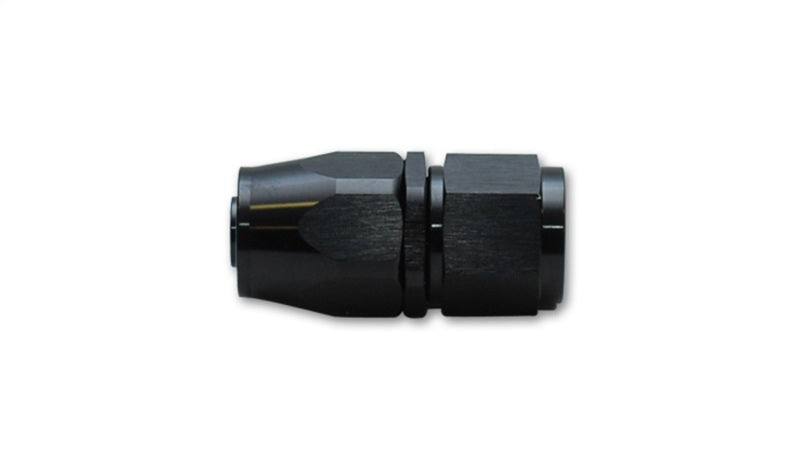
- Straight fittings work best when you've got a clean, direct shot with no obstructions
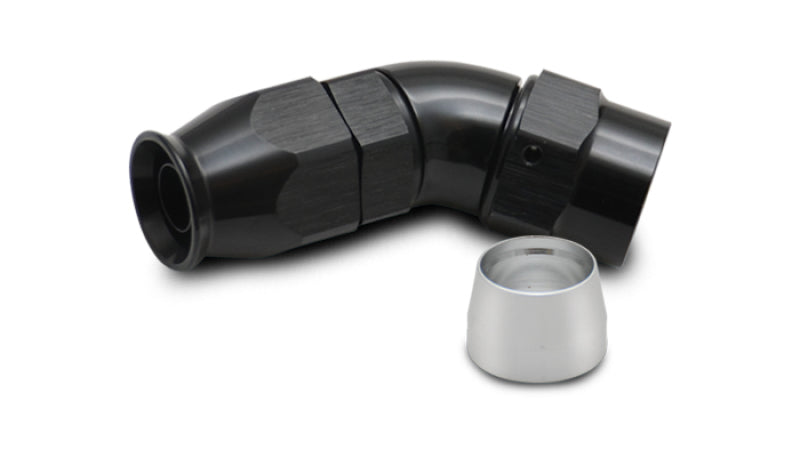
- 45° fittings are the most common all-around choice — enough bend to clear valve covers, chassis rails, and tight corners without a sharp kink
- 90° fittings are for tight engine bays where you need to make an immediate direction change right off the port — think turbo oil feed lines or fuel rails tucked against a firewall
Beyond the common three, you'll also find fittings in less common angles for specific routing problems:
- 30° and 60° fittings split the difference between straight and 45°/90° — handy when a standard angle either undershoots or overshoots the clearance you need around a bracket or manifold
- 120° fittings cover the gap above 90° for routing that needs to double back sharper than a 90° allows without kinking the hose
- 180° fittings (U-bends) reverse the line back on itself entirely — used when a port faces the wrong direction for your routing and there's no room to loop the hose around naturally
One more distinction worth knowing before you order: swivel vs. non-swivel fittings. A swivel fitting has a hose end that rotates independently of the fitting body, so you can dial in your final angle after it's threaded onto the port — great for hoses that need to line up just right, or for angled fittings where getting the rotation wrong means the hose kinks or rubs. A non-swivel (fixed) fitting is one solid piece with no rotation once assembled, which makes it simpler and often stronger for connections that don't need adjustment, like straight runs into a fixed port. If you're not 100% sure how a line will route until it's in the car, swivel fittings give you the flexibility to correct it without re-threading anything.
A good rule when planning a line: dry-fit everything before you cut hose or tighten anything down. It's a lot cheaper to swap a fitting angle than to redo a whole line because the routing binds against a bracket you forgot about.
Splitting a Line: Y-Blocks and Tees
Sometimes you need one line to become two — or two lines to become one — and that's where Y-blocks and tees come in.
Y-blocks merge or split flow at an angle rather than a hard 90°, which keeps things smoother for higher-flow applications. We typically run Y-blocks on fuel systems up to AN-10, and step up to Y-blocks in the AN-12 to AN-20 range for cooling systems where you're splitting or combining larger volume flow.
Tees split or join a line at a 90° branch and are the go-to on brake systems — think splitting a single master cylinder line to two calipers or combining a bias adjustment into the circuit. That said, tees aren't just a brake part; they show up plenty in fuel, oil, and coolant systems anywhere you need a simple 90° branch instead of the smoother angle a Y-block provides.
PTFE vs. Rubber Braided Hose — Which Do You Actually Need?
This one depends heavily on what's running through the line:
- Rubber braided hose (stainless or nylon braid over rubber core) is the budget-friendly, proven choice for standard pump gas and most street builds
- PTFE-lined hose is the move if you're running E85, methanol, or modern high-ethanol fuel blends — PTFE won't break down or swell the way rubber can with ethanol-heavy fuels over time
If you've upgraded to E85 and you're still running an old rubber-core fuel line, that's worth a second look before it becomes a leak you find the hard way. For a direct reference, see the Vibrant -6 AN PTFE flex hose or Vibrant -10 AN PTFE flex hose.
Quick Buying Checklist
Before you check out, run through this:
- Confirm your dash size matches your fuel pump/turbo oil feed requirements — not just "what looks right"
- Confirm your port thread type (JIC, ORB, or NPT) on both ends of every connection
- Pick your angle based on a dry fit, not a guess
- Match your hose material to your fuel type, especially if you're running E85 or methanol
- Don't forget hose ends and adapters — most lines need at least one adapter fitting to bridge between component thread types
Still Not Sure What You Need?
That's what we're here for. Whether you're plumbing your first fuel system or upgrading to handle more boost, our team can walk through your setup and make sure every fitting on the list actually fits, seals, and holds up. No gatekeeping, just answers — reach out or drop by the shop.